
For business, reservation давно is no longer just a folder of documents in the office. It’s about very concrete things: whether a shift will show up for production, whether a contract will fall through, whether there will be someone to keep the warehouse, deliveries, servers, or a repair crew running.
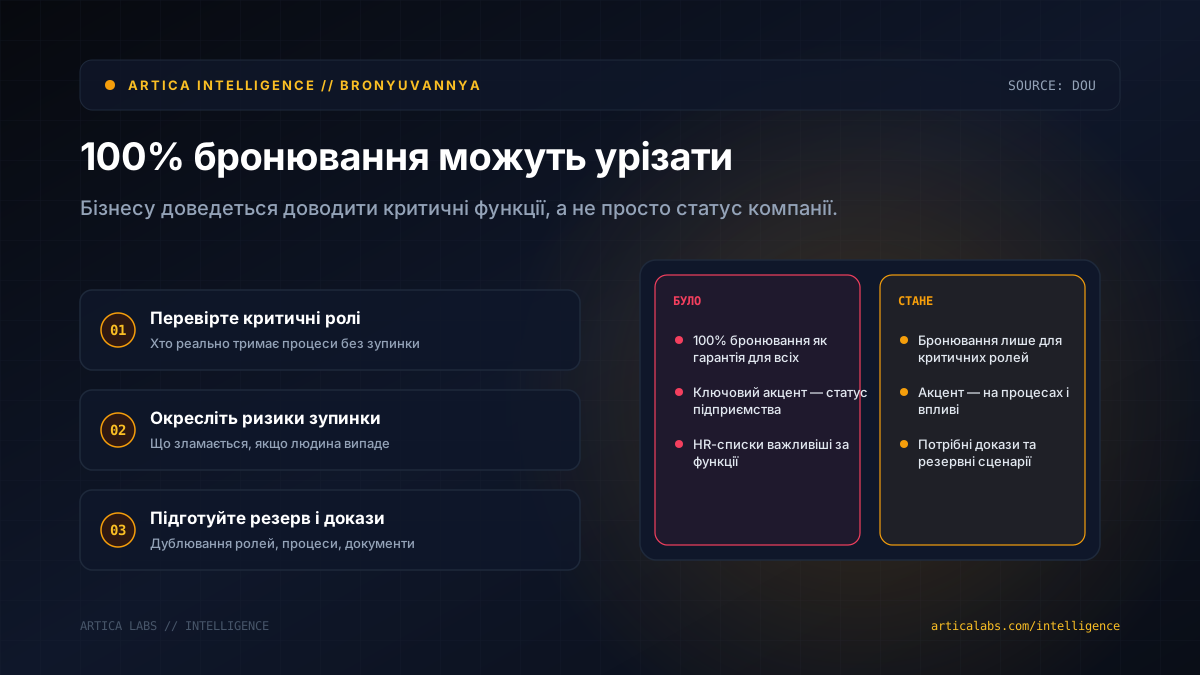
If the rules change, companies that are used to planning work on the assumption of 100% reservation may be in for an unpleasant surprise. Especially those that treated critical enterprise status as a guarantee for the whole team.
And this is where it gets interesting. The state, it seems, wants to separate genuinely critical functions from the formal status of a company. For an owner, that means one simple thing: it is no longer enough to be a “properly registered” business with salaries paid and taxes in order. You have to show which people actually keep the processes running that matter for defense capability or life support.
100% reservation came under review because of abuses
As DOU reports, the government is considering changing the reservation rules for employees of critically important enterprises. Prime Minister Serhii Koretskyi explained this by pointing to abuses: companies can expand headcount and reserve all employees, even if some of them are not performing critically important tasks.
According to him, the very idea of 100% reservation opens the door to large-scale manipulation. If an enterprise has the right to reserve everyone, it can effectively keep growing its team without limit and extend reservation to people regardless of whether they work in repair, energy, or other truly critical areas.
There is another signal for business. The number of reserved employees, the prime minister said, is additionally growing by tens of thousands every month. That is why the government wants to separate two issues: a company’s economic performance and its critical importance to the state. Paying salaries, having no tax debt, and maintaining a normal wage level do not by themselves prove that a company is critical.
According to DOU, a reduction in the share of reserved employees at critical enterprises from 100% to 85% is now being discussed. Preliminary changes could affect more than 900 enterprises in the defense-industrial complex. The idea has already been criticized by some defense manufacturers and associations, while the Ministry of Defense has not supported it.
It will be necessary to count functions, not headcount, because that is what keeps everything from stopping
The practical takeaway for executives is simple: do not wait for the Cabinet’s final decision before putting roles and processes in order. This is especially important if your company has critical status or plans to obtain it.
You can start with a short internal audit. Not for show, but to honestly see where the business depends on specific people:
- who really ensures continuity of critical processes;
- which tasks will stop first if a person drops out of the schedule;
- where roles are duplicated, and where operations rely on one person alone;
- which documents confirm a specific team’s contribution to critical activities.
Imagine a delivery service that serves medical or energy-related needs. For it, dispatchers, drivers on certain routes, and technical specialists who support the system may be critical. But are all office roles equally critical? These are exactly the questions that are likely to come up more and more often.
For IT companies and SaaS businesses, the logic is the same. If a product supports important infrastructure, you need a clear map: which engineers, DevOps specialists, or support staff ensure uninterrupted operation. Not vague wording like “we support the product,” but a direct link to processes.
The problem is that businesses often describe people’s value in HR language, while the state looks at it through the lens of functions and impact on defense or life support. That is why we would already be preparing not only employee lists, but also a map of operational dependence: process, responsible role, shutdown risk, backup scenario.
Automation also helps here. It does not replace reservation, but it reduces dependence on manual work. If approvals, reporting, request handling, or incident monitoring depend on one person, that is a weak point. It is better to close that gap with process, systems, and knowledge redundancy than to hope the rules will not change.