
For business, this story is not about “some big operator got hit somewhere.” It’s about a very specific question: what happens to your online store, CRM, clinic appointment system, or delivery service ticketing platform if the site where it all runs physically disappears overnight?
That is exactly what happened to DataGroup’s data center. According to DOU, as a result of Russia’s overnight ballistic attack on October 19, the data center’s equipment and infrastructure were completely disabled. The company said the facility could not be restored or kept in operation. The only good news in this grim story: no employees were injured.
DataGroup continues to serve customers from backup sites. And that’s where things get especially interesting for business owners. Because there’s a huge management gap between “we have a server” and “we can survive losing an entire site.”
A backup site has to work in real life, not just in a presentation
According to DOU, this was not the first damage to DataGroup’s infrastructure. On September 25, the operator had already reported damage to this data center. At the time, the company said customer data had been preserved and part of the services had been moved to backup sites.
For small and mid-sized businesses, there’s an uncomfortable but useful lesson here. A backup on its own does not save a business. What saves it is a well-rehearsed recovery scenario: who starts the backup copy, where it is stored, how long failover takes, and which services come back first.
Take an online store as an example. The product and order database backup exists. But the site is down, payments are not going through, managers can’t see order statuses, and customers are writing across every channel they can find. Formally, the data is safe, but sales are frozen. Or a clinic: even if the patient database is intact, you still need to quickly bring back the schedule, telephony, booking forms, and admin access. Otherwise the workday turns into manual chaos.
The October 19 attack was massive. According to the Ukrainian Air Force, Russia used Iskander-M/S-400 ballistic missiles, Iskander-K cruise missiles, and 269 attack drones. Ukrainian air defenses neutralized 247 aerial targets. In Kyiv, hits were recorded at 25 locations, and downed targets and debris also fell at eight locations.
This is the context in which Ukrainian business operates. Pretending that digital infrastructure lives in some separate safe reality is no longer an option.
What to check this week, without big meetings or unnecessary drama
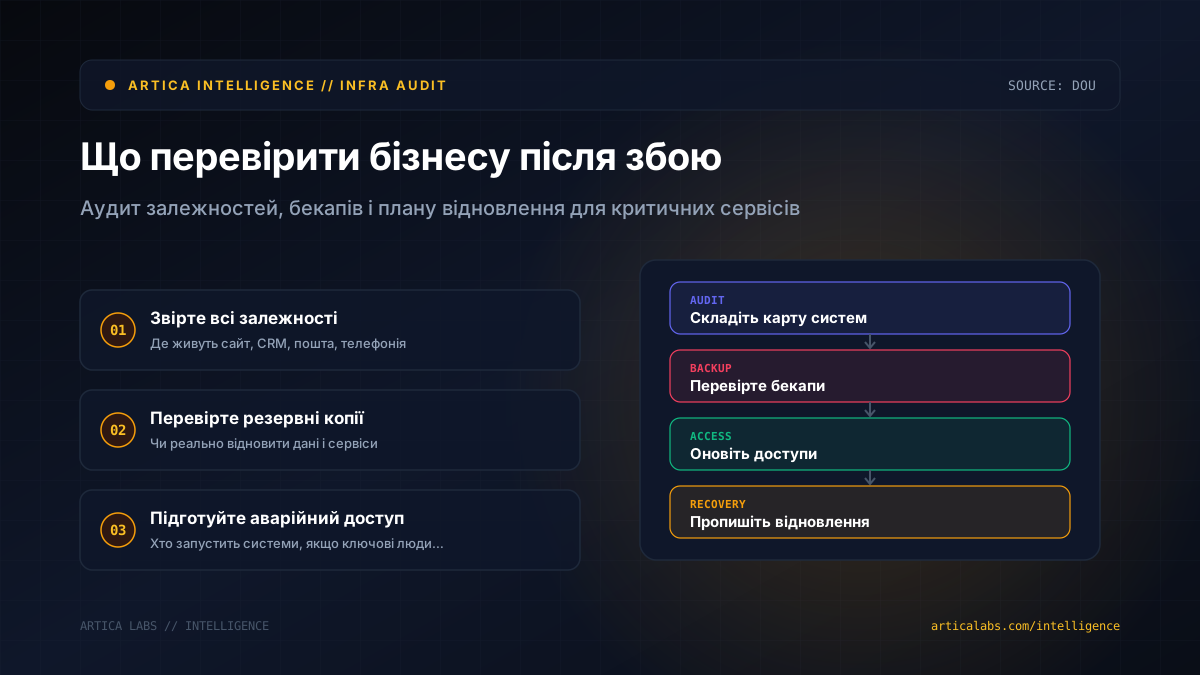
We would start not with buying another server, but with a short dependency audit. In plain language: map out what keeps your operations running.
- Where are your website, CRM, ERP, customer database, email, and telephony hosted physically or in the cloud?
- Do you have backups, and when was the last time you actually tried restoring from one?
- Who has emergency access to bring services back online if your technical specialist is unavailable?
- Which processes can be handled manually for a while, and which ones stop sales or support immediately without IT?
- Do you have a communication plan for customers during an outage?
The catch is that redundancy often exists only “on paper.” The provider promised something, the contractor set up backups long ago, access credentials are sitting in a chat, and someone “definitely knows how to get everything back up.” Until something breaks, it even looks like order.
For founders of SaaS companies, agencies, e-commerce businesses, and companies with a high volume of operational requests, this check should be part of basic hygiene. Not paranoia — normal management work. Check it, document it, test it. And only then automate the repeatable parts with workflows, monitoring, and alerts.
The news about DataGroup is painful. But it makes one thing very clear: a business is held together not by an optimistic plan, but by a prepared fallback route. It’s better to find a weak point during a drill than on the night when the main site is already gone.