
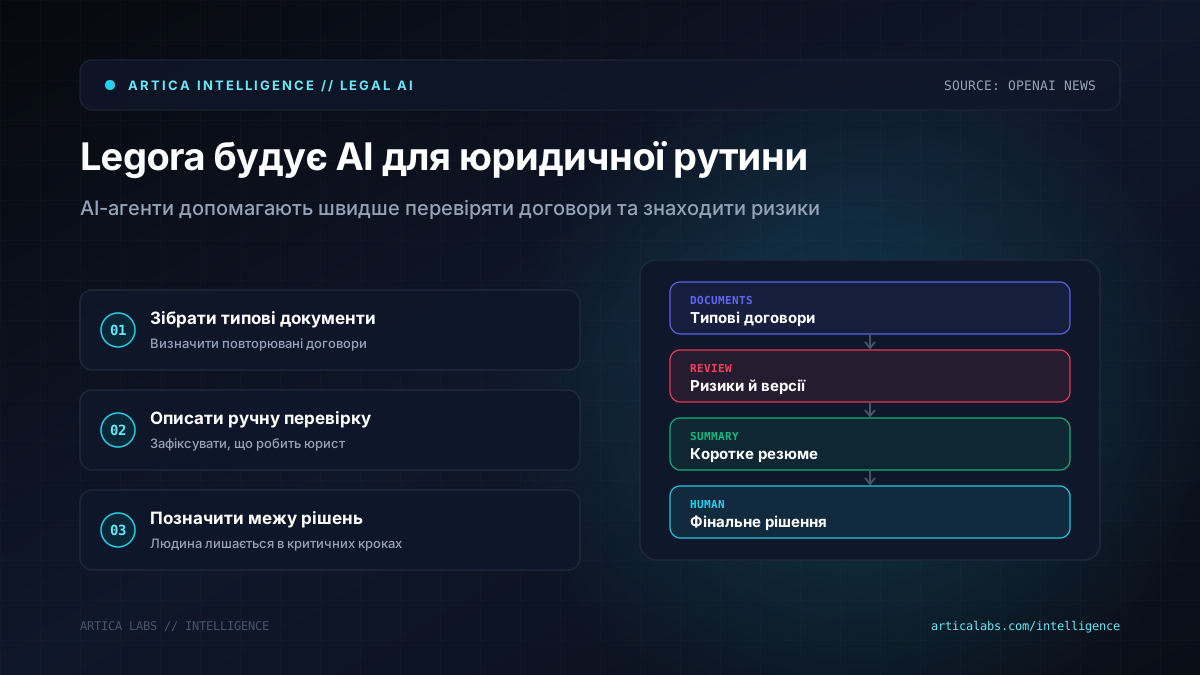
OpenAI News reports that Legora is building an agentic operating system for legal work. Its approach is based on OpenAI models, ChatGPT, and Codex. They are meant to help legal teams move faster, analyze contracts more deeply, and free up time for more complex work.
The public announcement doesn’t include many details, so we won’t invent features, pricing, or integrations. But the direction itself clearly shows where legal routine in business is heading.
Because what usually happens in practice? Someone needs to review a standard contract, spot risky wording, compare two versions of a document, or prepare a short summary for leadership. That’s not all of legal work, of course. But these are exactly the kinds of repetitive tasks that AI agents are likely to take on first.
The lawyer doesn’t disappear, but the routine should change
Imagine an e-commerce business that constantly negotiates supplier agreements. Or a clinic handling leases, contractors, and marketing contracts. Or an agency that reviews similar client agreements every month.
In that kind of setup, AI doesn’t replace a lawyer with a magic button. And that’s a good thing. What it can do is surface the spots a person should review more closely: unusual terms, risky wording, inconsistencies between versions, and passages that should be condensed into a short summary for the owner or director.
We’d start not with choosing a tool, but with some simple homework:
- collect the standard documents and identify which ones repeat most often;
- define exactly what a lawyer or manager is currently checking manually;
- set the boundary where the decision must still be made by a human.
That’s where things get interesting. Once a process is described in plain language, it can already be partially automated with an AI agent, RAG, or a workflow in n8n or Make.
Not to sign contracts blindly. But to prepare a document faster for proper legal review and avoid spending hours on mechanical checks of the same recurring details.