
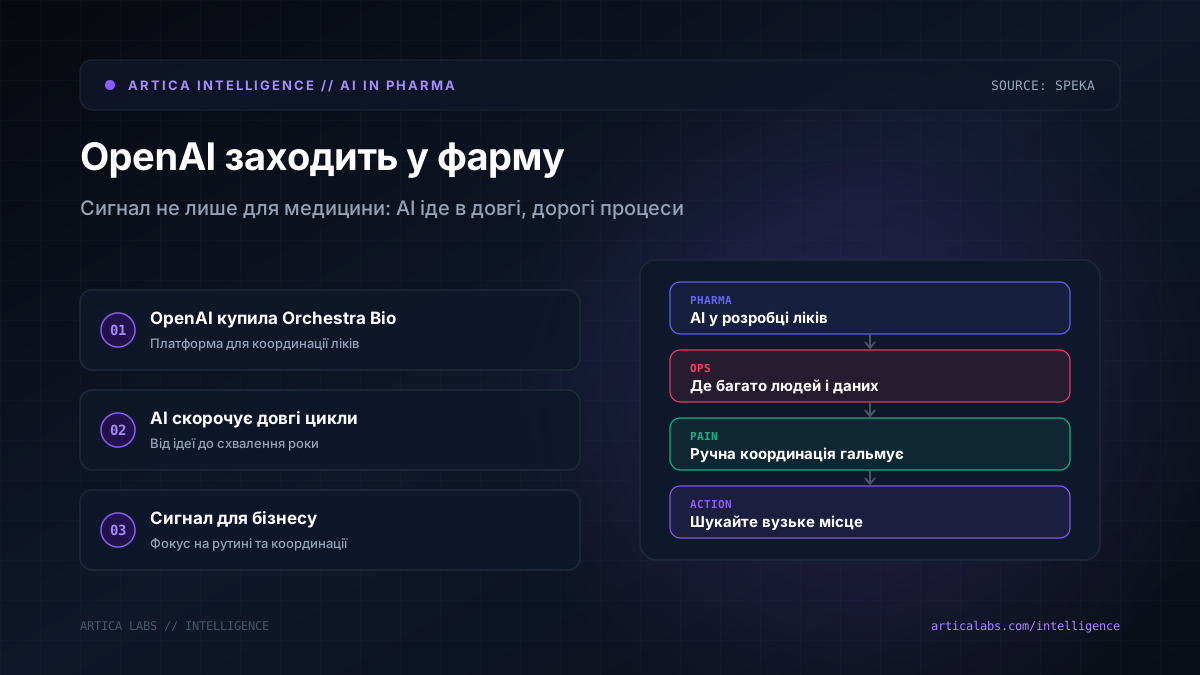
OpenAI has made its move into pharma. According to Speka, the company has acquired the startup Orchestra Bio, which built a platform for coordinating drug development. OpenAI announced the deal in its blog.
The context here is telling. In the U.S., it takes an average of 10–15 years to go from an idea to an approved drug. OpenAI wants to shorten that path with artificial intelligence.
There aren’t many details about the deal in the source, so we won’t invent anything that isn’t there. But the direction itself is significant. AI is increasingly being tested not where you need to generate a text or an image quickly, but where processes are long, expensive, and painful.
AI is moving into processes with lots of people, paperwork, and waiting
For a business owner, this isn’t just another “something happening in pharma” story. It’s a signal with very practical implications.
Artificial intelligence isn’t interesting only as a website chatbot, a presentation assistant, or a post generator. Its most tangible value may come where work drags on for months, depends on many participants, and constantly gets stuck in paperwork, approvals, spreadsheets, and scattered data.
Imagine a clinic. There are patient records, internal protocols, doctors’ schedules, and communication with administrators. Some information lives in a CRM, some in messengers, and some in people’s heads. Now imagine an online store where managers manually reconcile orders, stock levels, supplier replies, and delivery statuses. The scale is different, but the problem is familiar: the process relies on manual coordination.
And that’s where things get interesting. In such tasks, AI doesn’t look like “magic.” It becomes a normal operational tool: helping people find information faster, combine data from different sources, suggest the next step, and take routine work off managers’ plates.
What businesses should check in their own operations right now
You don’t need to chase every flashy promise. But it is worth taking a calm look at your own long processes and honestly identifying where your team loses time.
- Where do decisions depend on manually searching for information?
- Where do employees copy data between services?
- Where do approvals stall because of documents, spreadsheets, or email threads?
- Where does a manager effectively act as the “human integrator” between CRM, email, messengers, and the warehouse?
That’s usually where sensible AI experiments begin. Not with a big six-month transformation, but with one specific bottleneck. For example, automation through n8n or Make, RAG for searching internal documents, or an AI agent that helps a team handle routine requests.
At Artica, we look at news like this without any unnecessary hype, but also without skepticism for skepticism’s sake. When OpenAI buys a platform for coordinating drug development, it doesn’t mean AI will replace every complex process tomorrow. It won’t.
But it does clearly show the direction of travel. Artificial intelligence is gradually moving from polished demos into heavy operational work. And businesses are better off understanding that sooner rather than trying to catch up with competitors later.