
TechCrunch AI writes that more and more AI agents are appearing on the market that work directly inside text messages. What’s interesting here is not the idea of “just another bot in chat.” What’s interesting is user behavior: people already spend their day in messengers, where they make arrangements, reschedule meetings, set reminders, and lose track of part of their tasks.
When the assistant lives where the daily chaos already is
The article mentions Martin, a general-purpose personal assistant. You can reach it via SMS, phone, WhatsApp, email, Slack, and an iOS app. It helps with calendars, email, reminders, tasks, notes, and communications.
Martin can also act on the user’s behalf: send messages or make calls. Another useful feature is daily summaries of what needs attention. Pricing starts at $21 per month.
The second example is Maverick, an AI companion for text conversations. It fixes mistakes, cancels subscriptions, schedules meetings from voice notes, and helps group chats agree on a date for an event. A nice detail: before taking action, Maverick asks for permission.
The service integrates with Discord, Gmail, and Slack. Maverick is currently in beta and is free in iMessage. The Pro plan costs €27 per month and includes 500 tasks, 20 connected apps, scheduled tasks, and memory.
For business, this is less about the AI hype and more about small routine work
For small businesses, the signal is quite practical. Imagine an online store, a clinic, or an agency. A lot of daily chaos often lives not in the CRM or task manager, but in chats, voice messages, reminders, and phrases like “message the client tomorrow.”
If an agent can neatly extract tasks from that flow and ask for permission before acting, managers don’t have to keep everything in their heads. That doesn’t replace processes, but it can eliminate a few small daily misses: a forgotten follow-up, an unscheduled meeting, a lost agreement in a group chat.
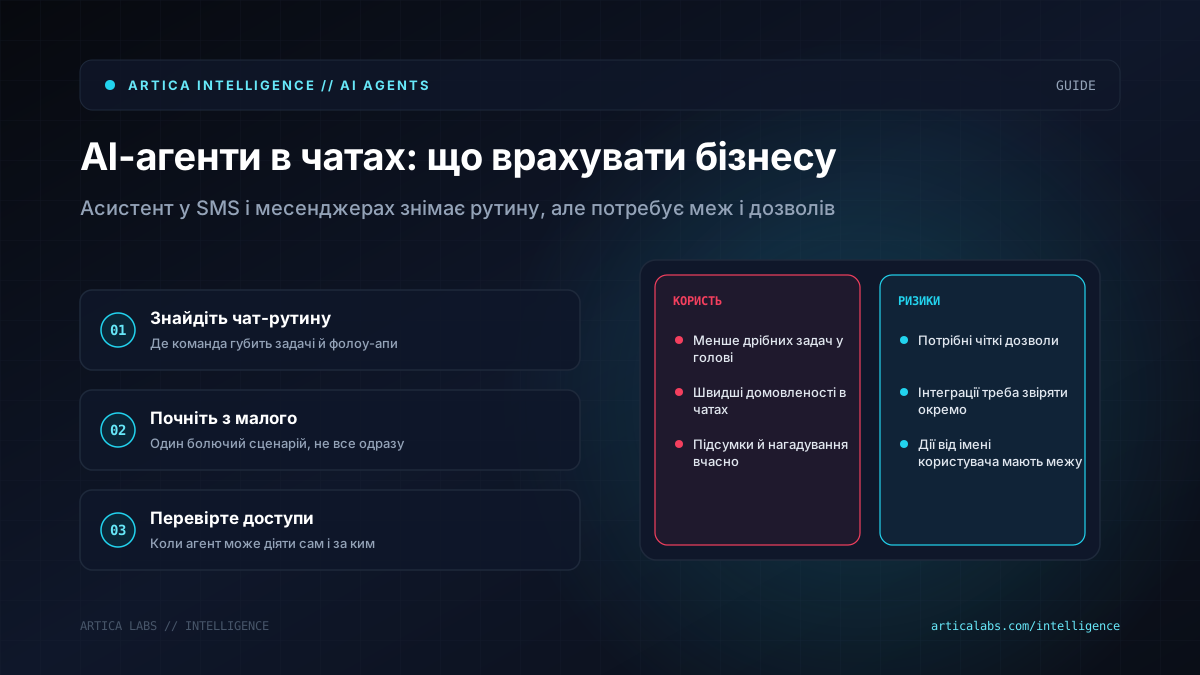
We wouldn’t recommend rushing to connect everything at once. It’s better to first look at which recurring actions in your team already happen in chats:
- meeting coordination;
- reminders for managers and clients;
- follow-up after calls or voice messages;
- next-step messages after a request, consultation, or delivery.
These small scenarios are the logical place to start testing. Not with broad automation for everything, but with one painful area where mistakes happen regularly.
And that’s where it gets interesting. Permissions, integrations, and the moment when AI gets the right to act on your behalf all need separate checks. Because one thing is reminding a manager to message a client. Quite another is sending the message yourself, canceling a subscription, or making a call. For business, the line between convenience and risk runs right there.