
A customer writes at 11:15 p.m. with a simple question. A manager will reply in the morning. By then, the customer may already have bought from someone who answered right away.
Sound familiar? For an online store, clinic, agency, or delivery service, this isn’t theory — it’s everyday routine.
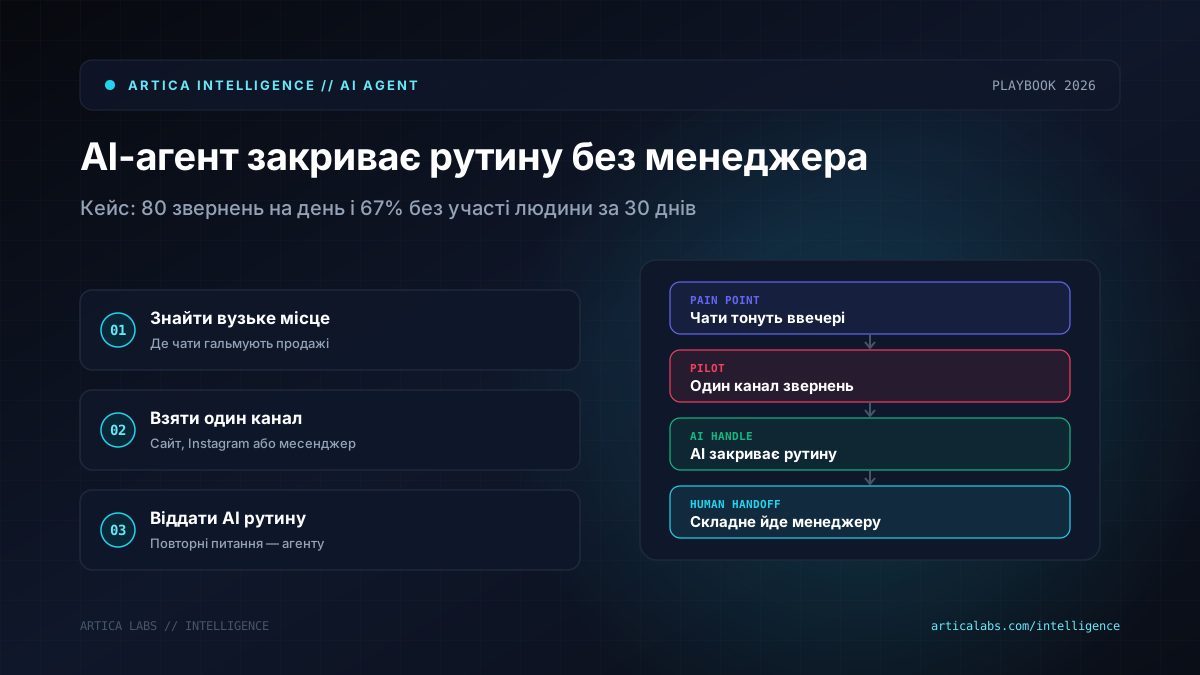
As Speka writes, that’s exactly how the case of a mid-sized company began: 12 employees on staff, 80 inquiries a day, and an owner who didn’t like chatbots. Thirty days after launching an AI agent, 67% of inquiries were being handled without a person in the loop.
67% of inquiries without a manager — this isn’t about the AI hype
The number itself proves nothing yet. What makes it interesting is something else: it shows where AI already makes practical sense. In repetitive conversations where the customer wants a quick answer, not a reply in the morning.
Imagine an online store where half the messages are about stock availability, delivery, or order status. If an AI agent handles those questions, managers don’t disappear. They simply stop putting out small fires and spend more time on sales, complex requests, and difficult customers.
And that’s where things get interesting. Automation makes sense not when “everyone is doing AI.” It matters when your business has a bottleneck: the team can’t keep up, replies get lost, customers wait, and the owner doesn’t want to hire more people without a clear business case.
Where to start if your inboxes are drowning too
You don’t need to start with a major transformation. For small and mid-sized businesses, that often means unnecessary stress for the team and unnecessary costs for the owner.
It’s better to pick one inquiry channel — say, the website, Instagram, or a messenger app — and calmly look at what’s happening there. Which questions repeat themselves? Where do managers spend the most time? What can be handed off to an AI agent without risking the customer experience?
- count the typical inquiries;
- define what AI can handle;
- leave complex and sensitive situations to people;
- measure the share of inquiries handled, response quality, and team workload.
An AI agent should not pretend to be human or try to solve everything. Its job is to handle routine requests quickly and pass the complex ones to a manager in time.
For many companies, that is already enough to avoid losing customers in the evening, on weekends, or during peak demand. And to grow without the automatic assumption that you need to hire another person.