
Picture a familiar scene. It’s evening, you’re sitting with your laptop. In your notes, the product already has a name, a few future dashboard screens, a feature list, and an estimated price. The idea feels obvious. You can already see internet stores, clinics, or marketing agencies using it. The team nods along. All that’s left is to find developers and finally start.
And then, the next morning, the uncomfortable question shows up. What if only we need this? What if the problem is real, but people are not ready to pay for it? What if they already get by with Excel, Telegram, a CRM, or an assistant, and your new product becomes just another login nobody opens?
This is where many startups make an expensive leap. They build a product to validate the idea. When often it should be the other way around: first validate the idea, then decide what kind of product actually makes sense to build.
An idea doesn’t need code. It needs proof
At the beginning, an idea almost always sounds convincing. Especially if it comes from your own pain. A agency owner wants a platform that automatically pulls together reports. A clinic manager dreams of a system that cuts the chaos in patient scheduling. A founder of an e-commerce project sees a service that analyzes margin, stock, and ads on its own.
The problem is not that these ideas are bad. The problem is that they rest on assumptions. Who exactly has this pain? How often does it happen? What do people do today? How much do they lose because of the current process? Who makes the buying decision? Will a new product be a priority when there are salaries, taxes, ads, logistics, and daily fires to put out?
Validating an idea before development is not supposed to prove that you’re right. It’s supposed to show where you’re wrong. That’s unpleasant for the ego. For the budget, the schedule, and the team’s nerves, it’s extremely useful.
A good idea test does not answer the question of whether people like the concept. People often like other people’s concepts, especially when they cost nothing. The more interesting question is whether the audience has a painful enough process that they already pay for with money, time, or risk. If yes, you have raw material for a startup. If not, you may just have a nice presentation for now.
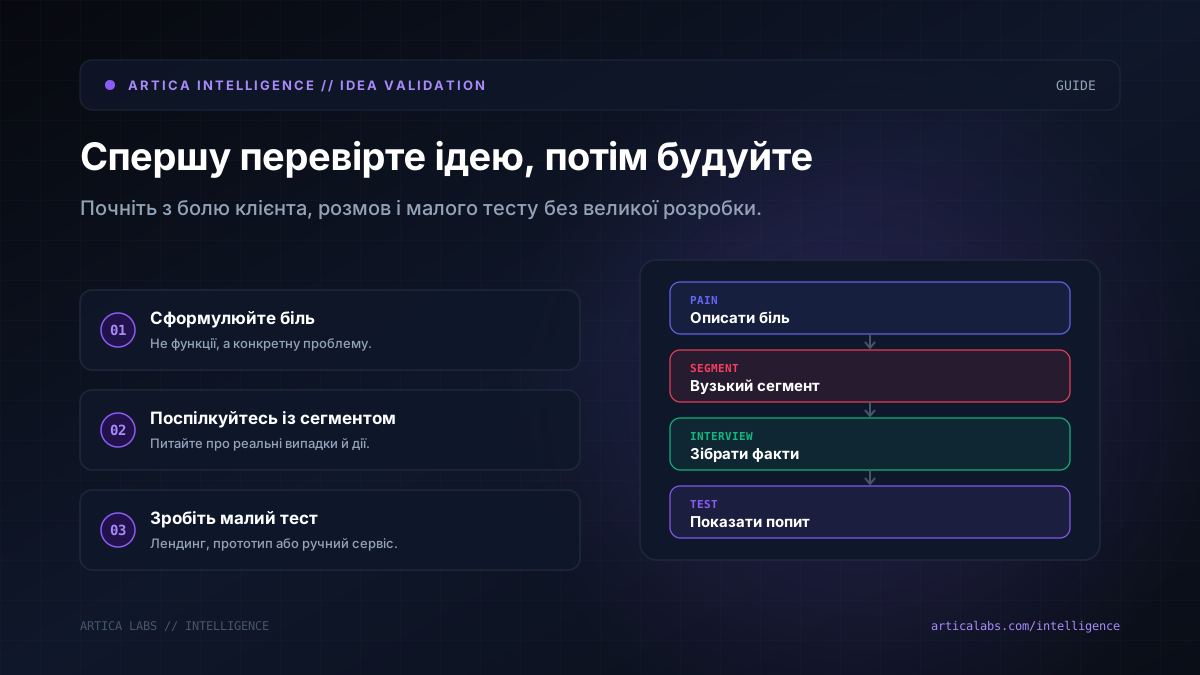
Start with a concrete pain, not with features
The most common false start is describing the product through features. For example: dashboard, integrations, analytics, AI assistant, mobile version. That looks like a development plan, but it doesn’t look much like market validation.
It’s better to begin with a very down-to-earth formulation: who exactly is hurting, in what situation, and what breaks because of it. Not small businesses need automation, but an online store owner manually reconciles ad, warehouse, and sales data every Friday, so they notice too late which products are eating margin. Not clinics need AI, but a clinic receptionist spends the whole day calling patients back because people miss appointments or mix up the time.
The difference is huge. The first version opens the door to imagination. The second lets you go talk to real people and check whether this is actually how things work.
At this stage, it helps to split the audience. Not all customers are the same. A delivery service with ten couriers has one set of problems; a multi-city chain has another. A founder who sells to the first customers personally has one buying logic. A company with a CFO, a lawyer, and a tender process has a completely different one.
If the segment is too broad, validation gets diluted. You’ll talk to different people, hear different pains, and end up with a chaotic list of wishes. Then it’s very easy to decide you need to build everything at once. And that’s where things get interesting. The budget grows, focus disappears, and the product still doesn’t have a single paid signal.
It’s better to choose a narrow segment and one situation. For example, not a service for restaurants, but a tool for small coffee shop chains that manually track write-offs and purchases every day. That’s not forever. It’s an entry point for validation.
Customer conversations should feel a little uncomfortable
Most first validations start with interviews. But interviews are easy to mess up. If you ask Do you like this idea?, people will usually be polite. If you show a polished mockup, they’ll say it looks interesting. If you ask whether they would use the product, some will say yes. That means almost nothing.
Stronger questions focus on past behavior, not future promises. When was the last time you had this problem? How did you solve it? Who was involved? How long did it take? What happened when you did nothing? Did you ever try to buy a solution? Why did you walk away?
Say you want to build a SaaS tool to automate reporting for marketing agencies. Don’t start by showing a future dashboard. Talk to the agency owner or operations manager about the last reporting period. Where was the data? Who collected it? What annoyed the client the most? Were there mistakes? Would the agency be willing to pay if some of the manual work disappeared, even if the process had to change a little?
The discomfort is that some of the answers won’t please you. You may learn that the problem exists, but a junior specialist solves it and the owner doesn’t feel the pain. Or that the pain is real, but it happens once a month and isn’t enough for a standalone product. Or that people don’t need another service, they need a setup in the CRM they already use.
That’s not a failure. That’s data. Failure is spending development budget and then learning the same thing at demo time, when changing the product is already painful.
How to test demand without heavy development
Validation doesn’t end with conversations. Conversations reveal context, but not always willingness to act. So after an interview, a person needs a small next step: leave a request, book a pilot, agree to a manual test, pay a deposit, sign an intent letter, or at least set aside time for a follow-up meeting with the decision-maker.
One of the simplest ways is to make not a product, but a simulation of value. A landing page with a clear pain and offer. A clickable prototype without a backend. A manual service where you do by hand what the product will eventually automate. A spreadsheet, a scenario in n8n or Make, a simple AI agent for an internal test. That’s nothing to be ashamed of. Early on, you don’t need perfect architecture. You need a market answer.
A short plan you can work through before full development:
- Define one audience and one situation where the pain appears.
- Describe how the customer solves the problem today without your product.
- Run a series of conversations with people from that segment. Ask about past actions, not whether they like the idea.
- Write down the phrases customers repeat. Don’t translate everything into startup language right away.
- Draft a simple offer: what result the customer gets and what they need to do to get started.
- Show a landing page, prototype, or manual process and ask for a concrete action.
- Test pricing at least conversationally: what feels justified to the customer, and what triggers resistance immediately.
- Estimate which parts of the solution can be done manually or with off-the-shelf tools.
- Set criteria: after which signals you move to an MVP, switch segments, or kill the idea.
- Don’t add new features until you understand which single action creates the most value.
Imagine a service for clinics that is supposed to reduce missed appointments. Before development, you can check several things very simply: talk to receptionists, map out the reminder process, build a test page for clinic managers, manually run a message flow for a few bookings, and observe how patients and the team react. There’s no need to build a full medical system right away. That would drag in security, roles, integrations, legal questions, and a long queue of decisions the market hasn’t validated yet.
How much resources this really takes
The first idea check should not look like a startup inside a startup. If it already requires backend, a mobile app, a design system, and a full team, then you’re probably not validating an idea—you’re testing the budget’s patience.
At the start, you usually need three things: the founder’s or owner’s time, access to potential customers, and someone who can quickly put together a test shell. That can be a no-code page, a request form, a Figma prototype, an automation in ready-made tools, or a simple script. If the product is technically complex, you may need a technical specialist who can tell you what can realistically be done later and what will become a trap.
The scarcest resource is not money. It’s the attention of the people you want to talk to. Cold messages and requests to give feedback work worse than a concrete topic. For example: we’re studying how small delivery services schedule couriers and calculate downtime. It’s easier for someone to respond if they see their own problem, not an abstract startup.
You also need the discipline not to fall in love with the first positive reaction. One acquaintance says they would buy it? Good. But that’s a signal, not proof. Three people praised the interface? Nice. But praise doesn’t pay the bills. A customer agrees to a pilot, gives access to the process, brings in a colleague, or discusses budget—that’s much more serious.
It’s also better to calculate the risks before writing code. There is market risk: the problem may not be painful enough. There is product risk: the solution may be awkward even if the pain is real. There is technical risk: what looks easy in a demo may be hard to support reliably. There is legal or operational risk: especially in healthcare, finance, HR, and work with personal data. There is sales risk: the user wants the product, but the person who pays sits in another office and has different priorities.
At an early stage, you don’t need to eliminate every risk. You need to understand which one can kill the project fastest and test that first.
Where validation often turns into self-deception
The first mistake is only talking to friends, acquaintances, and loyal customers of your current business. They can be useful, but they’re often too kind. They feel awkward saying the idea is weak or that they wouldn’t pay. You need people who owe you nothing.
The second is confusing interest with intent to buy. A person may genuinely care about the topic, read your posts, ask questions on a call, and still have no budget, no pain, or no authority. That’s why every validation should lead to action. A small one, but a real one.
The third is testing too many things at once. You launch a landing page, change the segment, add an AI feature, rewrite pricing, and at the same time talk to enterprise clients and small businesses. A month later you have lots of data and very little clarity. Better slower, but cleaner: one hypothesis, one segment, one next step.
The fourth is building an MVP as a shortened version of a big product. An MVP does not need to include all future modules in reduced form. Often a good MVP is one complete scenario that takes the customer from pain to result. For an online store, that might not be a full analytics platform, but an automatic alert about products whose ads are already eating the margin. For an agency, it might not be a full client portal, but fast assembly of one report without manual copying.
The fifth is ignoring sales before the product exists. Founders sometimes say: first we’ll build it, then selling will be easier. Sometimes that’s true. But if you can’t explain the value without a finished product, there’s a risk it won’t become much easier with one. Development does not fix a vague offer. It only makes it more expensive.
When it’s time to move to an MVP
The move to an MVP should not be an act of faith. The right moment comes when you see a repeated pain in a specific segment, understand the current alternative, have signs of willingness to act, and can describe the first scenario without ten and it would also be nice if conditions.
You don’t need a queue of customers. Early on, that’s rare. But you do need enough clarity not to build blindly. For example, you know that operations managers at delivery services manually reshuffle shifts every day, that mistakes hurt not only them but also the owner, that the solution needs to integrate with the existing system, and that the first useful scenario is quickly spotting the risk of too few couriers tomorrow. That’s already a solid foundation for an MVP.
At this stage, cut away the extra. If a feature does not help validate the main scenario, it can wait. If an integration is only needed by one potential customer, don’t make it part of the core right away. If AI looks great in the presentation but the user first needs a simple, reliable action, start with the reliable action.
Our editorial position is simple: a startup doesn’t win when it starts writing code faster; it wins when it faces reality faster. Reality is sometimes rough. It says the segment is wrong, the pain is weaker, the price doesn’t work, and the brilliant feature nobody asked for is unnecessary. But that’s exactly what makes it valuable.
An idea that survives validation without a product goes into development with more calm. The team has less fantasy and more grounding. The founder is less tempted to add everything at once. Future customers have a better chance of getting a solution that truly fits into their day.
If you need an outside perspective on validating an idea, an MVP, or automating the first manual process, Artica Labs can help at this stage. But the best thing you can do today without any contractor is open your list of potential customers and ask them uncomfortable questions about real life, not about your future dream.