
This news is interesting for business owners not because a founder moved to another startup. What matters more is this: even experienced teams are still figuring out where AI genuinely adds value and where it remains a polished demo for presentations.
Portal has already changed direction twice. And that says a lot about the state of the market. Personal AI assistants sound attractive, but the winners won’t be the ones promising the future the loudest. The winners will be the ones who learn how to handle the boring daily tasks of people and companies.
For small and mid-sized businesses, the signal is practical. If you’re looking at AI agents for email, calendars, sales, or customer support, you don’t need to wait for the perfect moment. But buying everything with AI on the label is not the best idea either.
Portal is looking for a product people are willing to pay for
As AIN.ua reports, former founder and CEO of the language platform Promova, Andriy Skrypnyk, has become a cofounder of the AI startup Portal. He is not disclosing his stake. Portal itself was launched in June 2024 by Volodymyr Panchenko, who previously sold DMarket to Mythical Games.
Initially, Portal was building AI solutions for marketing automation. In January 2025, the team changed the product and moved into a social network where AI generates videos on demand. Then came another pivot. The startup launched Portal One, a personal assistant.
Portal One works with email and calendar, searches and compares offers, and remembers user context. In other words, it steps into a very everyday zone where business hours are lost every day: emails, meetings, clarifications, looking for options, and small decisions.
According to a LinkedIn post by Panchenko, in the first 49 days after launch Portal One attracted 3,246 users, and the startup’s ARR reached $4 million. In total, Portal has already raised about $15 million and continues fundraising. The team is still small: three people work full time, and one more handles internal operations and team coordination.
Separately, Portal is developing Midos, an AI operator for the personal assistant that writes code, learns, and improves software. The company also sells it to other businesses.
And that’s where things get really interesting. Portal wants to be not only a tool, but also a future social network built around sharing information and experience. The ambition is big. But for business, the more important question is not that — it’s this: what specific work does such an assistant actually take off the team’s plate?
What businesses can take from this without $15 million in funding
First: don’t confuse an AI assistant with a magic button. If your processes are messy, the agent will just spread that mess faster across email, CRM, and calendars.
Imagine a clinic where administrators track patient appointments in different spreadsheets. AI can help with reminders, intake sorting, and draft replies. But if there are no unified booking rules, the result will be inconsistent. Everything works today, the patient gets booked into the wrong slot tomorrow, and the day after that a manager spends time fixing it.
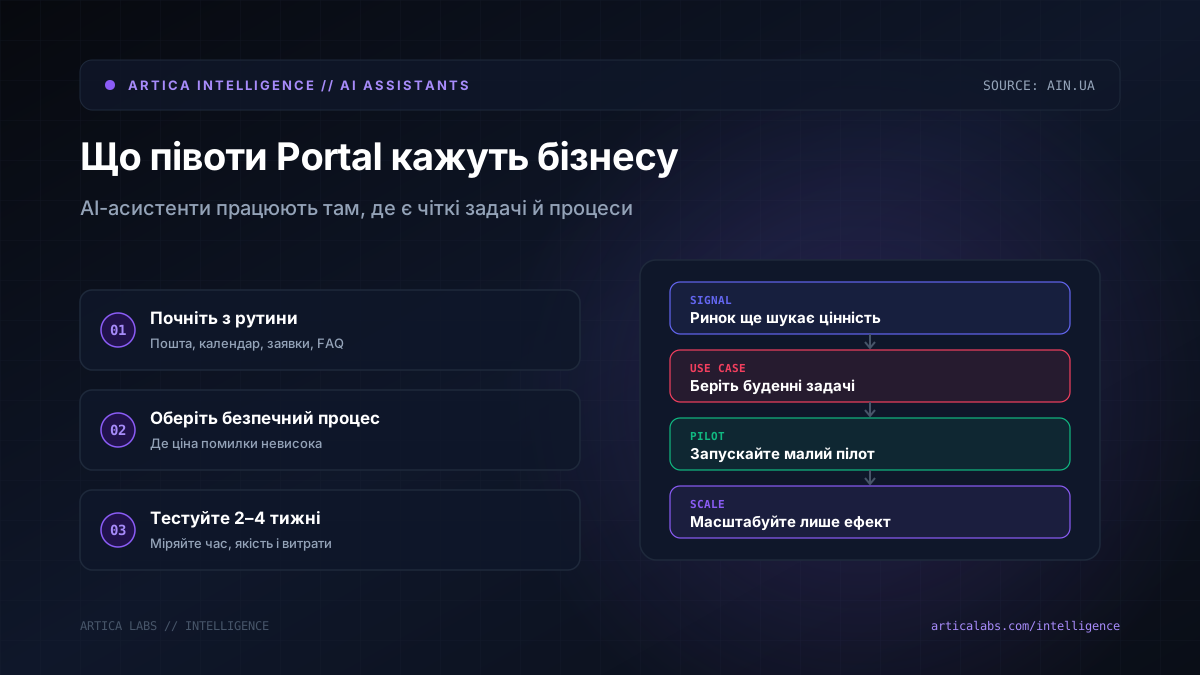
It’s better to start with tasks where the rules are clear and the cost of mistakes is not too high:
- processing requests, reminders, and draft emails;
- searching for and comparing information, such as vendor quotes;
- drafting support replies, with human review;
- internal assistants for managers who work with calendars, notes, and documents.
For an e-commerce business, that could be an agent that collects customer questions and drafts answers for an operator. For an agency, it could be an assistant that structures a brief, spots gaps, and reminds the team about deadlines. For a delivery service, it could be an assistant that helps dispatchers handle unusual requests faster.
Now for the less pleasant part. The pitfalls here are not new, but they are painful: access to email and calendars, data quality, accountability for mistakes, and customer data security. That is especially true in healthcare, finance, legal services, or any business where messages contain sensitive information.
We would not start with a large rollout. It is better to take one process for 2–4 weeks. Measure the time before and after. See whether it actually became faster, cheaper, or better. If not, that’s fine. It just means the tool is not right for that task, or the process is not ready yet.
Portal’s story is a good reminder: even strong teams change products when they see a better use case. Businesses can do the same. Don’t fall in love with the tool. Test the task, measure the impact, and scale only what works.