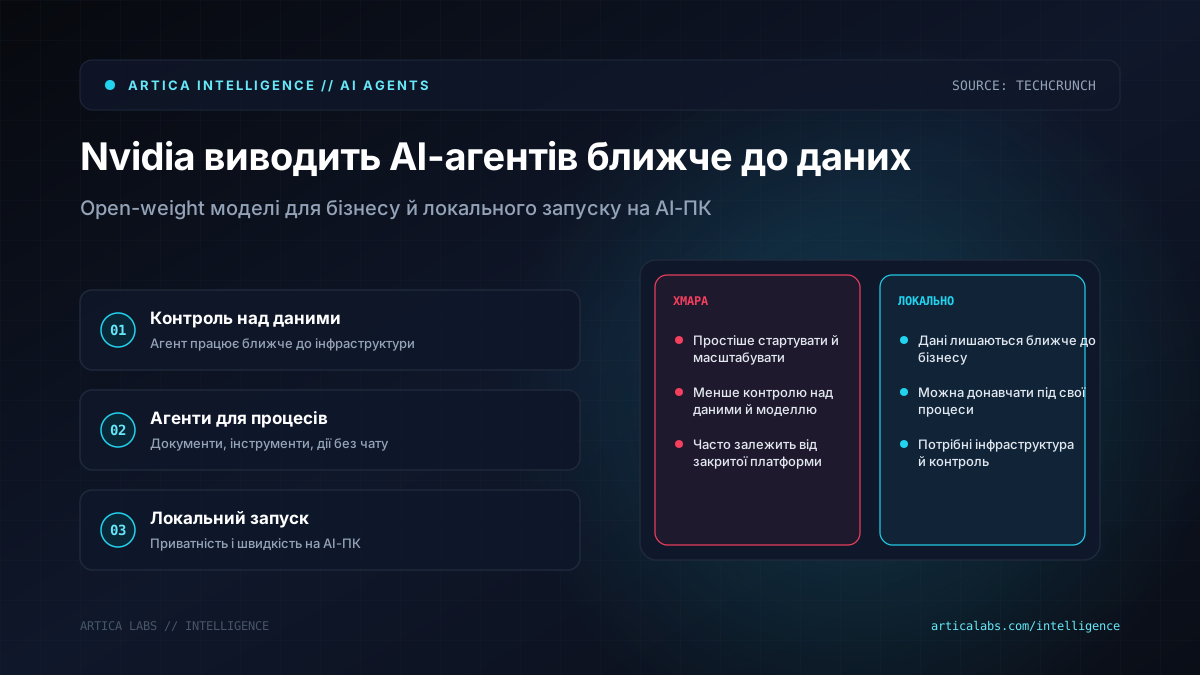
For business, this news isn’t just another model in a long stream of AI announcements. It’s about control. When an agent works with contracts, invoices, medical records, CRM data or financial reports, the owner cares about more than just how smart it is. The more pressing questions are simpler: where the data lives, who controls the model, and whether it can be trained for real company workflows.
Nvidia is moving in exactly that direction. As TechCrunch AI reports, the company has launched new open-weight models for always-on agents and edge computing. These are scenarios where AI doesn’t just answer in a chat window, but actually gets things done: it reads documents, uses tools, triggers actions, and can run closer to a company’s infrastructure — or right on the device.
More control over agents means more work for businesses
The main enterprise release is Nemotron 3.5 Super VL. It’s a large 120-billion-parameter model aimed at agents in enterprise environments. Nvidia says that although it has fewer parameters than Nemotron 3 Ultra, it should deliver similar accuracy in instruction-following and tool use.
The company also says Super VL performs certain agentic tasks faster than competing Anthropic and OpenAI models, provided it is further trained for specific scenarios. Nvidia says those scenarios include document workflows, financial accounting, scientific experiments, insurance claims, and cyberattack resilience.
That sounds impressive. But we wouldn’t read this as a ready-made answer to every business problem. Every major vendor presents itself in the best possible light using its own benchmarks, and that’s just how the market works. The real test still has to happen on your data, your documents, and your own mistakes.
What’s more interesting is the strategy behind it. Nvidia is betting on companies that want to run open models in their own data centers, fine-tune them on their own data, and avoid handing the entire process over to a closed platform. Among the companies Nvidia says are using Super VL are Skydance, EY, Ramp, Crowdstrike, Perplexity, and Salesforce.
For mid-sized businesses, this doesn’t mean you should buy a server tomorrow and abandon every SaaS provider. But the direction is clear. If you run a clinic, a logistics company, or a financial firm where sensitive documents move around every day, local or semi-local agents are becoming a more realistic alternative to cloud-only solutions.
AI on PCs: privacy is becoming an argument, not a bonus
The second part of the announcement is the lighter Bolt family of models. These are designed for local deployment on new AI PCs powered by Nvidia RTX Spark chips and DGX Spark workstations. Devices like these are already reaching the market through partners such as Microsoft and Dell.
Nemotron 3.5 Bolt 74B-A9B 24GB is a 74-billion-parameter model for local agentic tasks. It is designed to balance speed and reasoning, handle multi-step tasks, tool calling, and web browsing. A smaller model, Bolt E4B, is aimed at conversational agents and is expected to arrive later this month. Nvidia says Super VL and Bolt 74B-A9B are already available.
Picture a marketing agency. A manager wants an AI agent to gather materials for a presentation, review client files, draft an email, and keep all of that out of the cloud. Or an e-commerce business where support staff handle customer requests, but some payment and returns data needs to stay local. That’s the kind of private, on-device assistant Nvidia is trying to sell.
From a practical perspective, we’d start not with the model, but with one process. For example: invoices, applications, contracts, or customer inquiries. There needs to be repetitive document or tool-based work, otherwise the agent will quickly turn into a nice demo with no real value.
- Check whether local deployment is truly necessary. For some tasks, a cloud LLM will still be cheaper and simpler.
- Look at data quality. An agent on your own infrastructure won’t save a process if files are scattered, CRM records are messy, and workflow rules live only in employees’ heads.
- Build in security and monitoring from day one: access rights, activity logs, tool restrictions, and error testing.
Our view is simple: Nvidia’s open models do not make AI adoption easy. They give businesses more architectural options. You can build agents closer to your data, rely less on closed platforms, and tune the model more precisely for your workflows.
But there’s no magic here. Without solid task design, RAG, integrations, and control, such an agent will quickly become an expensive toy. And that’s where things get interesting: the winners won’t be the ones who deploy the model first, but the ones who prepare the work for it best.