
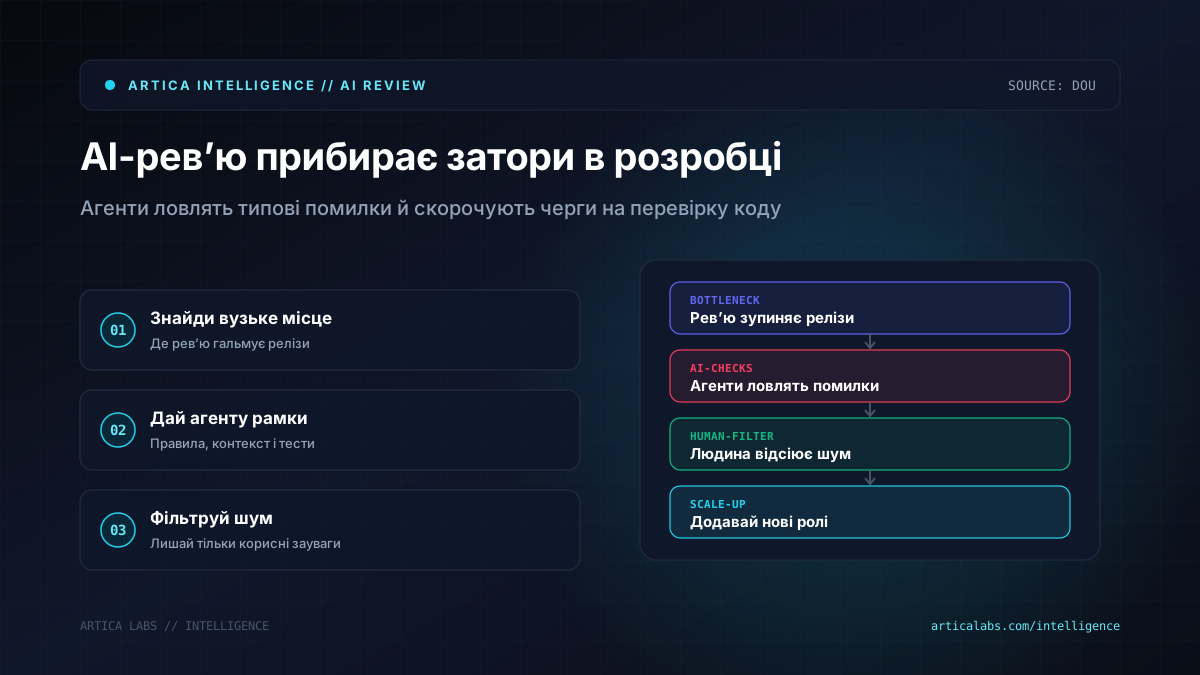
If your business is building an MVP, a SaaS product, or even an internal CRM, your team’s speed depends on more than just writing code. Very often, everything gets stuck at code review. A developer has already closed the task, but the change is waiting for review for a day, two, sometimes a week.
For a business owner, that may sound like a minor technical detail. In reality, the consequences are very tangible: releases slip, bugs pile up, and the team spends hours on manual routine work instead of moving the product forward.
And that’s where things get interesting. AI in code review is no longer limited to the “drop a file into chat and ask if it’s okay” scenario. As DOU writes, teams are testing setups where one agent writes code, another checks it, a third evaluates the quality of the comments, and tests run even before the pull request.
AI agents are already backing up reviewers
The reason is simple: there’s more code. According to DOU, GitLab set a goal of reaching 500 merge requests per engineer per month by the end of the year. That doesn’t necessarily mean “squeezing more out of people.” It’s more about removing friction where it eats up days. After all, one MR can sometimes be reviewed by two to ten people.
At Kube-DC, the scale is different: a project with 1.2 million lines of code, worked on by three people instead of the planned 15. Kube-DC founder Volodymyr Tsap described a cycle where one model wrote and tested the code, another looked for issues, the first fixed them, and so on in a loop. For a complex core component, there were about 140 such iterations in three days. A human would likely have been exhausted much earlier.
But AI does not replace common sense. It’s good at catching mechanics: rule violations, edge cases, test failures, and breaks in internal conventions. Imagine an online store. An agent can check whether new promo code logic breaks checkout. Or a clinic: whether a change in the admin panel exposes extra patient data. But whether the business actually needs that feature right now is not something the model can decide for the product owner.
Off-the-shelf service or a custom agent: it depends on team maturity
The DOU article offers a telling contrast. At GitLab, they adopted a built-in AI reviewer and added local verification stages. At Preply, they compared a custom reviewer with ready-made solutions on the same pull requests. In one test, there were seven intentional violations of internal DDD rules: the custom reviewer found all seven, CodeRabbit flagged three in regular comments, and marked four more as minor.
For business, the takeaway is pretty practical. If you have a small team or your product is just getting started, begin with off-the-shelf tools. Don’t try to build your own “GitLab Copilot” in the first month. First, identify where the pain actually is: bugs show up after release, reviews sit idle for too long, code is written in different styles, tests don’t cover everything.
A minimal plan could look like this:
- take 20–30 old pull requests with known issues and run the AI reviewer on them;
- don’t assign an LLM tasks that are better handled by linters, typing, and automated tests;
- document the team’s rules in guidelines and give the agent only the context it needs;
- run checks the same way locally and in CI, for example using the local parity approach, which the source links to Dagger;
- compare ready-made solutions with your own prototypes on the same tasks.
There is one downside here, and it’s an unpleasant one: noise. Once you have too many agents, they start flagging everything under the sun. Stylistic preferences. Risks that may not even be real. Duplicates of the same comment in different words.
That’s why you need a filter. It can be a lead agent that weeds out the unnecessary stuff, or a human who looks only at the final set of comments. Otherwise, the team will quickly stop reading those suggestions, even if some of them are genuinely useful.
Our view is simple: AI review makes sense not as a trendy toy for developers, but as a way to clear bottlenecks in product delivery. Start small: one agent, one type of check, one repository. Once the benefits and limits are clear, you can add roles for security, architecture, databases, or the UI. That’s how AI becomes part of the process instead of turning into yet another chaotic chat next to the team.