Most businesses don’t write cryptography, an HTTP client, or a file-processing library from scratch. Teams install packages, frameworks, SaaS modules, and integrations. That’s what powers an e-commerce store, a clinic’s CRM, a delivery service portal, or a startup MVP.
That’s why Anthropic’s new vulnerability scanner matters not just to open-source developers. It’s about a risk that sits quietly in your dependencies and then shows up in your product, customer data, and reputation.
AI has learned not only to read code, but also to spot dangerous spots
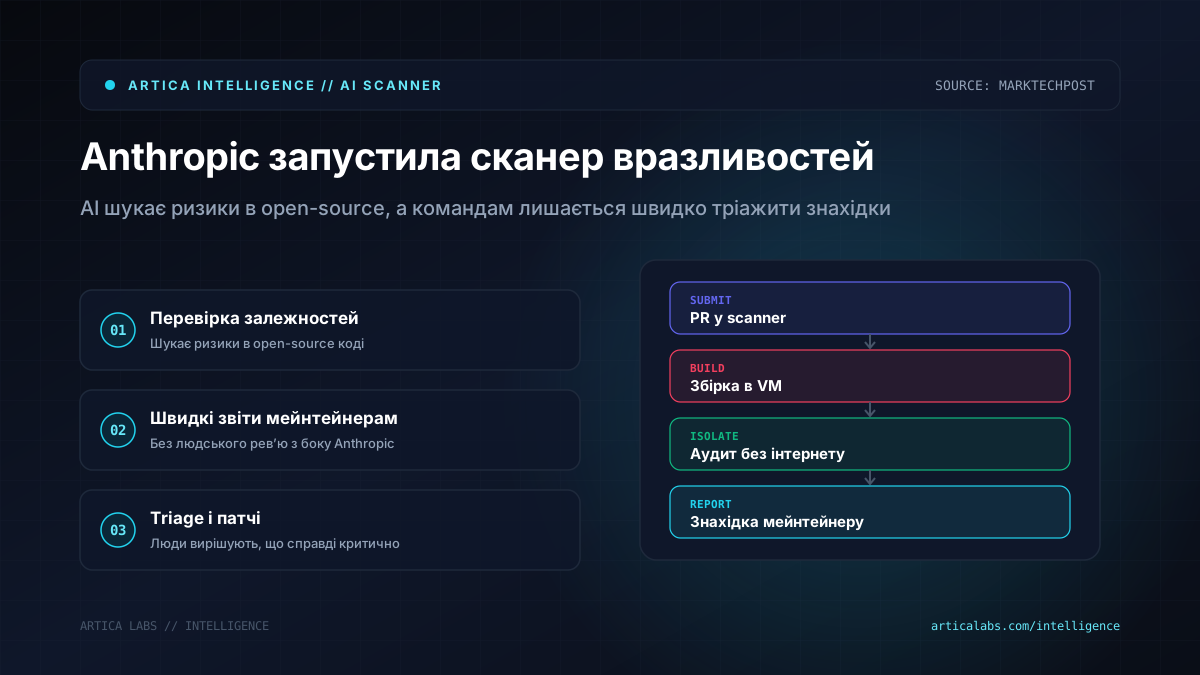
According to MarkTechPost, Anthropic has launched OSS Scanner — a free opt-in scanner for critical open-source projects. Under the hood, it uses the company’s strongest models, including Claude Mythos. Projects are submitted through a pull request to the anthropics/oss-scanner repository. The maintainer adds a configuration file, a contact person, and a Dockerfile.
After that, Anthropic builds the project in a virtual machine. Network access is available during the build stage, while the actual audit runs later in an isolated environment without internet access. The agent looks for problems, tries to validate the bug, explains the root cause, prepares a reproducible example and, if possible, suggests a patch.
The early numbers are notable. As of October 19, 11 days after launch on October 8, Anthropic had accepted 114 projects out of roughly 650 applications. During that time, the system produced 77 model-rated critical findings and 803 high findings. When 97 critical and high findings across 48 projects were reviewed, 85 — or 88% — met Anthropic’s coordinated vulnerability disclosure threshold. Eleven were real but duplicated known issues or other findings. Only one turned out to be a false positive.
There are concrete examples too. wolfSSL received 74 reports, 72 of which were deemed valid, and 5 became CVEs. curl fixed CVE-2026-92392 — a high-severity use-after-free in HTTP/2 upload. The vulnerability affected curl versions 8.12.0–8.22.0 and was fixed in 8.23.0, released on October 14, 2026.
Findings come in faster. Humans still have to sort them out
And that’s where things get interesting. Reports go directly to maintainers, with no human review from Anthropic. That saves time, but it shifts the main workload onto the project team.
For business, that means one simple thing: AI scanners will produce more signals. But someone still has to separate a real risk from a duplicate, an overstated severity score, or a problem that doesn’t apply to your use case.
Imagine a SaaS platform for doctor appointments. A high-severity report appears in one of your dependencies. The team needs to quickly figure out where that library is used: in production or only in dev tooling. Can an external user reach the vulnerable code? Is there already a patch? Do you need to temporarily disable a feature until the update is in place? That’s not the kind of decision you want to make in the chaos of 2 a.m.
From a practical standpoint, we’d start here:
- Inventory the open-source dependencies in your product, website, mobile app, and internal automations.
- Check who owns security advisories and package updates. Not “the developers somewhere,” but a specific role or person.
- For your own open-source components, prepare a threat_model.md: which inputs are dangerous, what is out of scope, and how severity should be assessed.
- Agree on triage: who reads the report, who reproduces it, and who makes the call on the patch and release.
At Artica, we look at tools like this without romanticism. They are not a replacement for a security engineer. But they are a powerful radar that can scan more code than a human can review manually. The real question is whether your business is ready to process those signals without panic or accidental decisions.