
For businesses, this news is interesting not because of yet another benchmark race. The point is elsewhere. AI agents that can work with code, tools, and long work context are gradually moving out of closed ecosystems and into open access. That means SaaS teams, automation agencies, internal IT departments, and companies that don’t want to depend on a single provider now have more options.
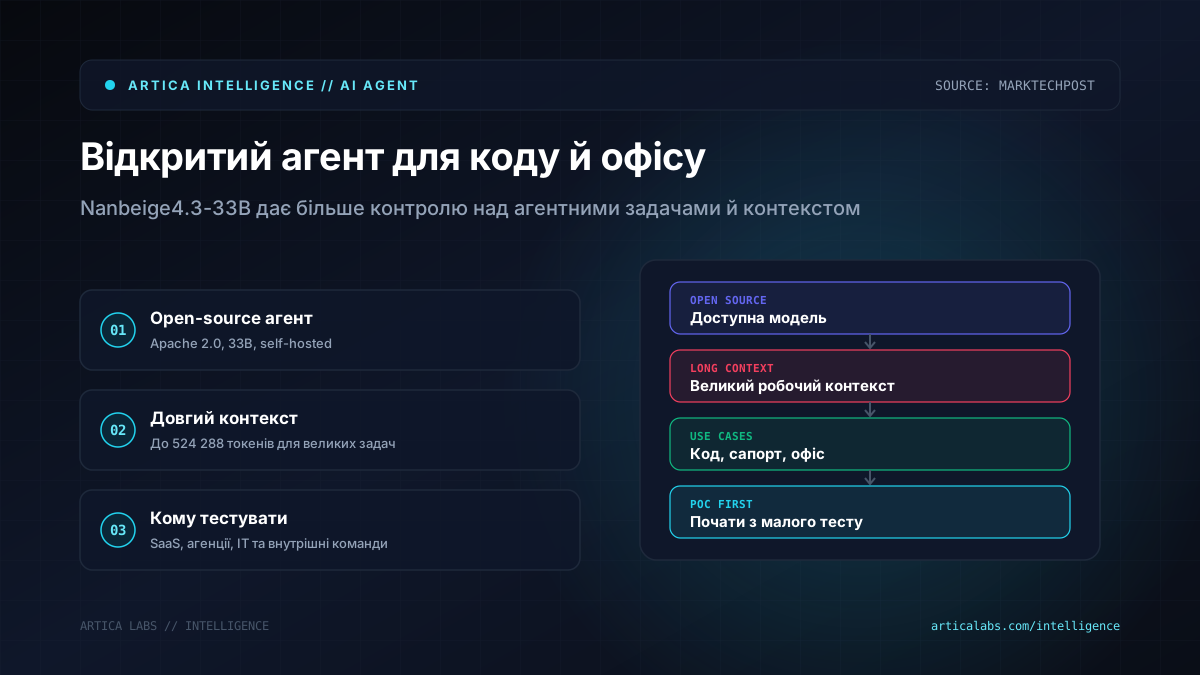
As MarkTechPost reports, Nanbeige LLM Lab has published the Nanbeige4.3-33B model on Hugging Face under the Apache 2.0 license. The lab operates inside the recruiting platform BOSS Zhipin. The model has 33 billion parameters, a dense architecture without MoE, and is built for agentic coding and office tasks in the form of an “AI employee.” A base version, Nanbeige4.3-33B-Base, is also available for custom fine-tuning.
Long context is not magic, but it is useful for real work
Nanbeige4.3-33B supports a context window of 524,288 tokens. In plain terms, you can feed the model a very large amount of working information: a repository, documentation, logs, instructions, task history. For a development team, that means better work with large codebases. For an operations manager, it means an agent that sees not just one email or ticket, but a wider slice of the process.
Imagine a delivery service. There are requests, statuses, response templates, compensation rules, and internal SOPs. An agent with a large context window could, in theory, not only reply to a customer but also check the logic behind the actions, suggest a process change, or prepare an instruction for an operator. In a clinic, a similar scenario could involve internal rules for scheduling and patient communication. In an agency, it could mean analyzing a technical brief, a CRM workflow, and integration code.
According to Nanbeige, the model leads in 17 out of 20 rows in its own comparison against open models around the 30B range. On Terminal-Bench 2.1, it scored 80.9 versus 73.0 for Qwen3.8-27B. On Automation Bench, 54.2 versus 38.3; on JobBench, 44.8 versus 34.5. There are also weaker spots. On SWE-Bench Pro, Nanbeige4.3-33B trails Qwen3.8-27B, 60.3 versus 61.7. And Terminal-Bench 4.0 came in at 23.8, the model’s lowest result in the table provided.
Who should test Nanbeige4.3-33B right now
First of all, this model is interesting for technical teams that already work with self-hosted LLMs or have reasons to keep data closer to their own infrastructure. For example, a SaaS startup that wants to experiment with a coding agent for pull requests, automated tests, or migrations. Or a company building an internal assistant for n8n/Make scenarios, documentation, and technical support.
And this is where it gets interesting. A 33B dense model is not the kind of thing you “just run on a laptop and go.” The SGLang and vLLM recipes mention 4-way tensor parallelism, which means multi-GPU servers. According to MarkTechPost’s math, BF16 weights require roughly 66 GB of memory. Long context also has a cost of its own: the more tokens and parallel sessions you have, the faster memory usage grows.
There is one more nuance. All results in Nanbeige’s table are self-reported. That does not mean they are untrustworthy. But it is not enough for a business decision. We would start not with a full process migration, but with a small test:
- pick 2–3 real tasks from code, support, or operations;
- compare Nanbeige with the model the team already uses;
- evaluate not only response quality, but also speed, infrastructure cost, and tool-calling stability;
- separately check how the model behaves in long conversations and whether it carries mistakes forward from earlier context.
Nanbeige also positions the 33B model as a “teacher” for the future Nanbeige4.3-3B. If the smaller version inherits part of the agentic skills, it could be more attractive for mainstream business use. For now, Nanbeige4.3-33B looks like a strong tool for R&D, technical teams, and companies that are already ready to pay for infrastructure and control.