
There are the dollars a business hasn’t earned yet. That’s unpleasant, but understandable. And then there’s a much more painful kind of money: it’s already almost yours, but it’s stuck in invoices, approvals, back-and-forth with suppliers, manual checks, and small discrepancies no one has time to chase down.
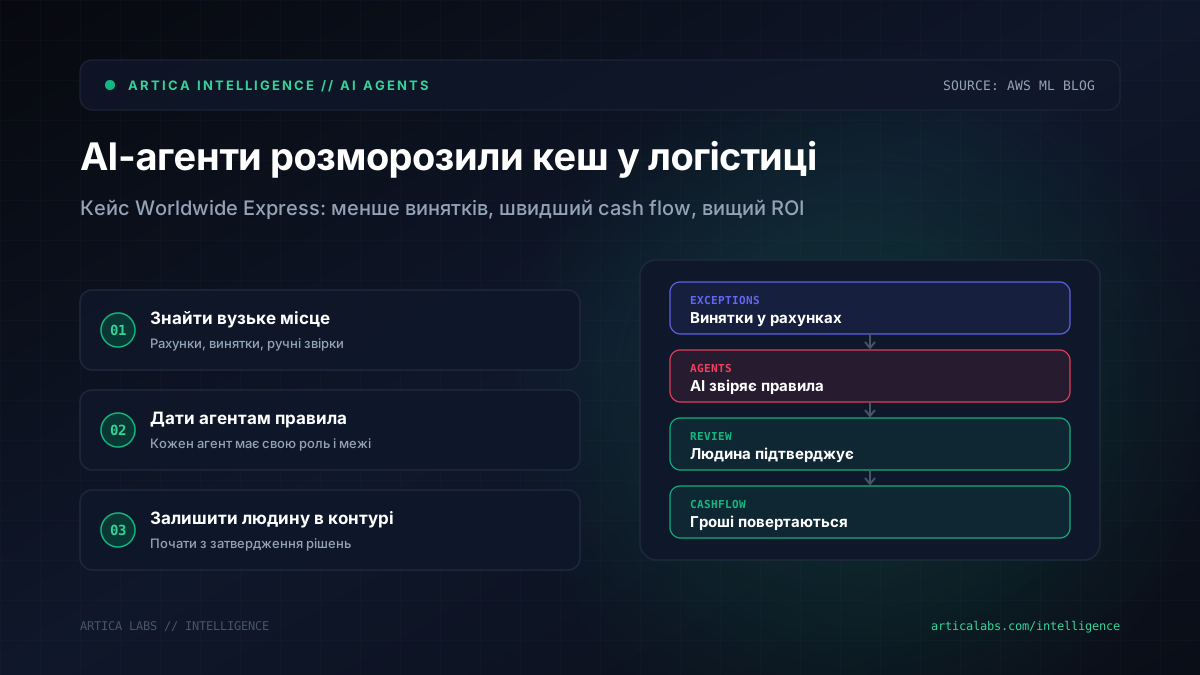
That’s why the Worldwide Express story is interesting beyond logistics. According to the AWS Machine Learning Blog, the company automated freight invoice exception handling with a multi-agent solution on Amazon Bedrock. Six months after launch, active exceptions were down 75%, time-to-cash improved by four weeks, and free cash flow increased by $10 million.
The process looks like it works, but the money is just sitting there
Worldwide Express operates at serious scale: roughly $5 billion in system revenue, more than 75 LTL carriers, and over 130,000 customers. Along with that scale came a familiar operational problem. Each month, about $15 million in free cash flow was tied up in billing exceptions.
In LTL shipping, around 14% of invoices fail the standard three-way match between the order, the service actually delivered, and the carrier’s bill. The reasons are very real: line items don’t match, the rate differs from the contract, or there’s an extra charge for a liftgate, residential delivery, or reweighing.
Before, people handled all of this. They reviewed the documents, looked for the source of the discrepancy, emailed the carrier or warehouse, waited for a response, and entered the decision into the SpeedShip TMS. And each carrier has its own rules, rates, and dispute process. Classic RPA hits a wall here pretty quickly: the process does not run on a straight track, and it needs context.
AI agents took over not the magic, but the rules-driven routine
Working with AWS and LTM, Worldwide Express built a solution that plugs into SpeedShip. Amazon Bedrock handles the AI reasoning, while Amazon EC2 handles execution and orchestration. The team did not hand over everything to the system. Quite the opposite: they chose a tightly controlled architecture, with each agent having a role, decision boundaries, available actions, and a response format.
The system runs three specialized agents:
- the invoice matching agent finds the relevant shipment record and shows exactly what doesn’t line up;
- the rate discrepancy agent compares the carrier’s charge with the contracted rate;
- the accessorials agent checks whether unexpected charges are backed by actual delivery events.
Before making a recommendation, the agent pulls in the rules for that specific carrier: tariffs, surcharge definitions, dispute procedures, and variance thresholds. After a decision, the system generates a short text note explaining what it found and what action was taken. At first, a person approved the recommendation in the SpeedShip interface. Once accuracy passed 99%, bulk approval became the default mode.
The result was very practical. In production, more than 40 LTL carriers are live, the agents close 10,000 exceptions per week — roughly 50% of the total flow — and the error rate is under 1%. The active backlog fell from $15 million in June 2025 to $4 million six months later. Annual savings exceeded $1 million, and first-year ROI came in at 60x.
Where to find this kind of impact in a smaller business
So what should a small or mid-sized business do with this? Definitely not copy AWS’s architecture one to one. A better starting point is to look for your own “exceptions”: invoices, returns, claims, supplier approvals, medical records, delivery tickets.
Imagine an online store where some returns get stuck because marketplace and courier rules don’t line up. Or a clinic where staff manually reconcile appointments, payments, and patient documents. That’s not the kind of case that needs a flashy transformation. It needs one repeatable bottleneck where many decisions look similar, but the rules vary slightly each time.
The first step is simple: pick one problem type, map the rules, connect the data, and keep a human in the approval loop. Then measure automation rate, errors, processing time, and the frequency of manual overrides. And that’s where things get interesting. Without a solid rules base, AI can sound very confident while explaining questionable decisions. In finance, healthcare, or logistics, that quickly turns from innovation into risk.
For us, the main takeaway from this case is simple: AI agents make sense where there is volume, variability, and a clear cost of delay. Automation starts not with a trendy tool, but with a sober question: where is our already-earned money sitting idle?