
Picture a familiar scene. Monday, 10:17 a.m. The owner of an online store opens the CRM and sees twenty-three new inquiries from the weekend. There are a few more questions about stock in Telegram. In Viber, a customer writes for the third time: “Will someone answer me?” One manager is on a call, another is sick, and a third is replying on Instagram. An hour later, some of those people have already bought elsewhere.
Or another scene. A small clinic spent money on advertising and got a flood of consultation requests. But the receptionist simply cannot call everyone back within the first few minutes. Some people don’t answer. Some don’t want to talk and ask to write in a messenger. Some ask the same questions over and over: price, available times, address, how to prepare for the visit.
This is exactly where businesses start looking at voice AI agents and messengers not as a trendy toy, but as a real sales channel. Not as a replacement for all managers. And definitely not as a magic button. Rather, as a way to close the gaps between advertising, first contact, consultation, and payment.
At Artica Intelligence, we see that interest in these solutions is growing not because people suddenly fell in love with technology. The reason is simpler: customers have become impatient, channels are fragmented, and attention is more expensive than ever. Even the TechCrunch Enterprise story about Blackwall, which pushed its valuation to $2.2B amid an increasingly overloaded internet, captures the broader backdrop well. A website and ads alone are no longer enough. Businesses need direct, fast, and controllable touchpoints.
Sales have long been happening in calls and chats. The question is who is managing them
Many business owners still think of messengers as support: answer questions, clarify delivery, send payment details. But in practice, that is often where the sale actually happens. The customer asks questions, hesitates, compares options, asks for advice, and wants to feel that there are real people behind the business.
A voice AI agent can handle incoming calls, make the first round of callbacks for leads, remind customers about appointments, and clarify order details. In a messenger, an AI agent answers common questions, helps choose a product, collects contact information, and hands complex conversations over to a human manager. It sounds simple. But the real power is not in the bot itself — it’s in the fact that the process finally becomes measurable.
For example, a delivery service receives lots of calls asking, “Where is my order?” If the operator has to open the admin panel every time, search by number, check the status, and read the answer back, that eats up time. An AI agent in a messenger can ask for the phone number or order ID, pull the status from the CRM or a spreadsheet, and answer without human involvement. If the order has a problem, it can hand over the conversation with a short summary.
Another example: an apartment renovation agency. Someone leaves a request on the website at 9:40 p.m. The manager will only respond tomorrow at 10:00 a.m. because the workday is over. An AI agent can immediately message them on Telegram or call, ask about the apartment size, renovation type, district, timeline, and budget range, then schedule a consultation on the calendar. In the morning, the manager sees not just “call Ivan back,” but a full context already collected.
That does not mean every business needs to rush and deploy a voice agent. If you only get ten inquiries a month, sell a complex high-ticket service, and rely on personal trust, start with a solid CRM and scripts. But if requests are repetitive, managers are drowning in routine work, and response speed affects revenue, automating the sales channel can deliver a noticeable result.
Start not with voice, but with a map of your conversations
The most common mistake we see in conversations with businesses is: “We want an AI bot that sells.” That’s roughly like putting a new sales rep on the line without product training, a CRM, discount rules, or even a clear understanding of who they’re allowed to promise what to.
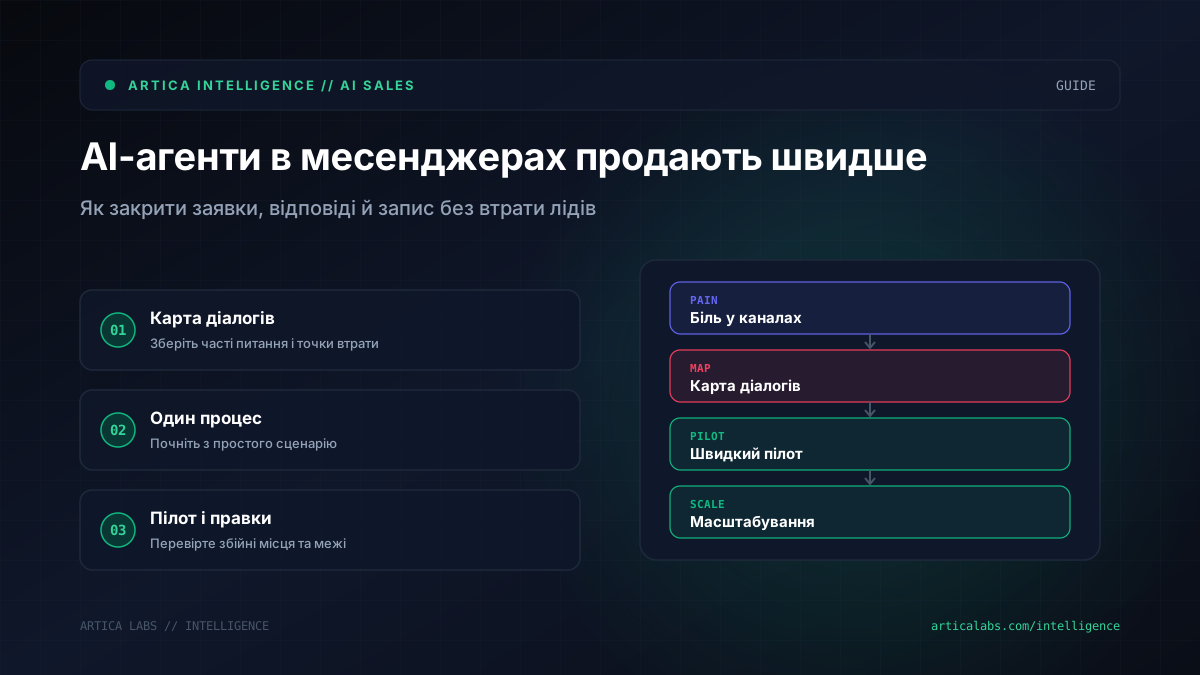
It’s better to start with a conversation map. Take the last hundred interactions in chats, calls, or the CRM. You do not need perfect analytics. Just list what people come in asking about: price, availability, product fit, delivery, appointment booking, complaints, repeat purchase, post-payment questions. Then separate what can be automated from what requires a human decision.
For an e-commerce store, a simple starting point is an AI agent in a messenger that helps customers choose a product, checks stock, explains payment and delivery, and collects contact details. Voice can be added later — for example, to confirm orders or reactivate abandoned requests, if that makes sense for your audience.
For a clinic, you need more caution. The agent can book appointments, remind patients about visits, and answer logistical questions. But it should not make diagnoses or recommend treatment. The boundaries here must be strict. Any medical question should go to an administrator or doctor.
For B2B SaaS, you can start with lead qualification. The agent in chat asks what role the person has, what task they need to solve, the size of their team, and what tools they already use. After that, it offers a demo slot, sends materials, or passes the lead to a sales manager. In this case, AI does not “close the deal”; it removes the chaos before the first call.
A 2–6 week launch plan without unnecessary architecture
You do not need to build a complex system right away with voice, a RAG base, integrations, analytics, and a dozen scenarios. For the first launch, it is better to pick one area where the pain is greatest. For example, the first contact with leads after a request. Or answers to common questions in a messenger. Or appointment confirmations.
- Choose one process that repeats every day and has a clear outcome: booking, inquiry, payment, consultation, confirmation.
- Collect real dialogs and calls from the last period. If you pass them to a contractor or team for analysis, remove personal data.
- Define the agent’s boundaries: what it can promise, what questions it asks, when it hands over to a human, and what it is not allowed to say.
- Prepare a knowledge base: prices, terms, FAQs, limitations, hours, addresses, return rules, current services.
- Connect one channel. It’s often better to start with Telegram, WhatsApp, Viber, or web chat, and add voice after the scenarios have been tested.
- Set up integration with a CRM, spreadsheet, or at least a form where the agent stores requests. If the data gets lost, the sales channel turns into pretty noise.
- Launch a pilot on part of the traffic, not on all customers at once. Watch where the agent gets confused, where people get annoyed, and where managers’ workload actually drops.
- Review conversations every few days. Add answers, refine prompts, remove unnecessary chatter, and improve handoff to a human.
Resource requirements depend on complexity. The smallest launch can be built with ready-made automation tools, a messenger, an LLM, and a simple knowledge base. If you need voice, integration with telephony, CRM, calendars, payments, and internal systems, the scope grows. And you need to allocate time not only for development, but also for testing conversations. That is usually where half the work hides.
The team at the start also doesn’t need to be large. You need someone from the business side who understands sales and the product. You need a technical specialist or an integration team. And you need a responsible manager who will review conversations after launch. Without such an owner, the process will quickly go stale: prices change, promotions change, schedules change, stock changes, and the agent keeps answering with outdated information.
Voice agents are not a fit everywhere
Voice has one advantage that is hard to ignore: it’s closer to the traditional sales experience. Many people still prefer to solve issues by phone, especially when something is urgent. Clinic appointments, delivery, service, real estate, cars, education, repairs, legal consultations. In those areas, a call is often alive and valuable.
But a voice AI agent is also riskier. In chat, the customer sees text, can reread it, and can calmly switch to a human manager. In voice, a mistake sounds harsher. Response delays are more irritating. An unnatural tone can be off-putting. If the agent mishears an address or amount, that becomes an operational problem.
That’s why voice works best in scenarios that are sufficiently structured. Confirm an appointment. Remind someone about delivery. Clarify a few request parameters. Offer to reschedule a consultation. Take an incoming call after business hours and create a task for the manager. For a first version, that is much safer than asking the agent to negotiate a complex B2B contract.
An important topic is tone of voice. Businesses often want the agent to sound “like the best salesperson.” In reality, customers usually need clarity. Less pressure, more specifics. If someone asks about delivery costs, don’t start with the company’s history. If they want to book an appointment, don’t launch into a long questionnaire without explaining why you need the data.
Honest positioning works well. Don’t hide the fact that it’s AI if that could create mistrust. You can say: “I’m an automated assistant — I can help you book an appointment or connect you with a manager.” That removes unnecessary expectations. People are fine with automation when it saves time and doesn’t pretend to be something it isn’t.
A messenger can be a storefront, checkout, and CRM. Or it can turn into chaos
Messengers are powerful because the customer is already there. You don’t need to make them install a new app or search for a form on your website. They write the same way they write to friends, contractors, or a courier. For small and medium-sized businesses, that matters a lot.
But a messenger as a sales channel can fall apart quickly. One manager replies from a personal phone. Another forgets to add a tag. A third agreed to a discount but didn’t log it in the CRM. The owner sees activity, but not the funnel. How many inquiries were there? How many were qualified? Where did people drop off? Which questions repeat? No answers.
An AI agent in a messenger is useful when it is not sitting there as a separate widget, but is connected to the process. A person messages about a product. The agent clarifies the size and color, checks stock, creates a request, tags it as a “hot lead,” and hands it to a manager if discount approval is needed. After the purchase, it can send instructions, a checklist, delivery status, or a review request. Not all at once, but the logic should be exactly that.
For marketers, this is also a source of the customer’s real language. In chats, people phrase objections without any polishing: “too expensive,” “I don’t get the difference,” “what if it doesn’t fit,” “I need it by Friday.” If these conversations are analyzed, you can improve ads, landing pages, assortment, and scripts. AI can help classify inquiries, but the decision still has to be made by a human.
There is a thin line between useful automation and being intrusive. If someone just asked about business hours, don’t attack them with a sequence of messages the next day. If a customer has declined, don’t act like you didn’t hear it. A messenger channel is very personal. It’s easier to burn trust there than on a website.
It’s better to sort out the risks before launch, not after complaints
The first risk is wrong answers. An LLM can phrase something beautifully but inaccurately. For sales, that is dangerous: the wrong price, a non-existent promotion, a promise of same-day delivery when the warehouse is closed. This is solved not by magic, but by constraints. The agent should pull data from an up-to-date source, avoid making things up, and hand over to a human whenever it’s unsure.
The second risk is personal data. Phone numbers, addresses, order histories, medical or financial details cannot be carelessly moved between services. You need to understand where the data is stored, who has access, what integrations are being used, and what gets logged in the systems. In some industries, additional legal advice is required.
The third risk is broken handoff — the moment the client is transferred to a human. If the transfer is bad, the customer has to repeat everything from the beginning. That is frustrating. The manager isn’t happy either, because they only see fragments. A proper handoff should include a short summary: who reached out, what they want, what they’ve already been told, and what the next step is.
The fourth risk is the owner’s inflated expectations. An AI agent will not fix a bad product, a confusing offer, chaotic pricing, or the lack of someone responsible for sales. It can speed up a good process. It can partially organize a mediocre one. But if nobody inside the business knows what a normal customer conversation should look like, the model will not invent it for you.
The fifth risk is a lack of operational discipline. You launch it, celebrate, and forget about it. A month later the price list changes, two months later a new service appears, and three months later managers start bypassing the system because it’s inconvenient. The agent becomes a source of errors. That is why, before launch, you need to decide who updates the knowledge base, who reviews problematic dialogs, and who has the authority to change the scenarios.
Our position: start with one small but real process
Voice AI agents and messengers as a sales channel should not be treated as a separate IT project sitting off to the side of the business. They are part of your funnel. If the funnel is built badly, the customer will feel it before you even have time to open the analytics.
We like the approach where a business takes one painful area and makes it work properly. Not “AI for all sales,” but a fast response to leads after advertising. Not “a bot that knows everything,” but an assistant that books consultations accurately and stays away from areas that require a specialist. Not “automate the managers,” but remove repetitive tasks from their day so they can focus on more complex conversations.
If, after launch, it became easier for customers to buy, easier for managers to work, and easier for the owner to see what’s happening in the channel, that’s a good result. If the agent talks too much, gets confused, hides problems, and creates another layer of chaos, it’s better to stop and redesign the process.
The technology is mature enough now to bring value to small and medium-sized businesses. But it requires adult supervision: boundaries, control, testing, and updates. Start with real conversations, not a polished demo. That is where the first version of your AI agent lives — in the live questions your customers actually ask.
If you want to assess which sales automation scenario makes sense for your business, the Artica Labs team can help with a process audit and a prototype without all the unnecessary AI noise around it.